
Ordivis Network
Subnet tree, utilisation, DHCP reconciliation and active network scanning – linked to the CMDB instead of kept beside it. An unlimited number of addresses and networks, with no surcharge per node.
# Subnet tree with utilisation
10.0.0.0/8        Corporate network
 ├─ 10.20.0.0/16   North site
 │   ├─ 10.20.1.0/24  Servers   88 %
 │   └─ 10.20.9.0/24  Clients  41 %
 └─ 10.30.0.0/16   South site

10.20.1.14  app-srv-04  static · CI linked
10.20.1.15  free        Scan: no response
IPAM (IP address management) is the central administration of the IP addresses, subnets and address ranges of a network – including the question of which device sits behind an address and whether it is still in use at all.
It answers three questions at which spreadsheets reliably fail: which address is free? Who owns an occupied one? And how full is this subnet actually? The first two decide how quickly a new server gets onto the network. The third decides whether you plan a network migration in good time or carry it out under time pressure.
An Excel list is correct on day one and a little less so every day after. It verifies nothing: an address stays recorded as assigned although the device was decommissioned long ago. Two colleagues assign the same address because both had opened an older copy. And as soon as nobody trusts what it says any more, people scan instead of looking up – and then the maintenance was for nothing.
Ordivis Platform therefore actively reconciles the documented state against reality: through DHCP import and through an active network scan including MAC address capture.
The DHCP console knows only the dynamically assigned addresses of its own server. IPAM keeps the whole picture: static and dynamic addresses, reserved ranges, networks with no DHCP at all and documented planning for segments not yet rolled out. The DHCP console is an operational view – IPAM is the planning and evidence layer above it.
A hierarchical prefix tree with a utilisation display per network. You see which segment is getting tight before the first request for a free address runs into nothing.
Every address with its state, purpose and assignment – free, reserved, assigned. No guessing whether a gap is intentional or an oversight.
Import of the DHCP assignments: the documented state is checked against the actual allocation, deviations become visible instead of silent.
A reachability check with MAC address capture. Occupied addresses without an entry stand out – as do entries with no device behind them.
Addresses hang on configuration items, not on free text. On the CI the IP appears read-only – linked, never copied.
Addresses and networks are unlimited in every tariff. Complete documentation therefore does not become a budget question – unlike with tiers based on managed nodes.
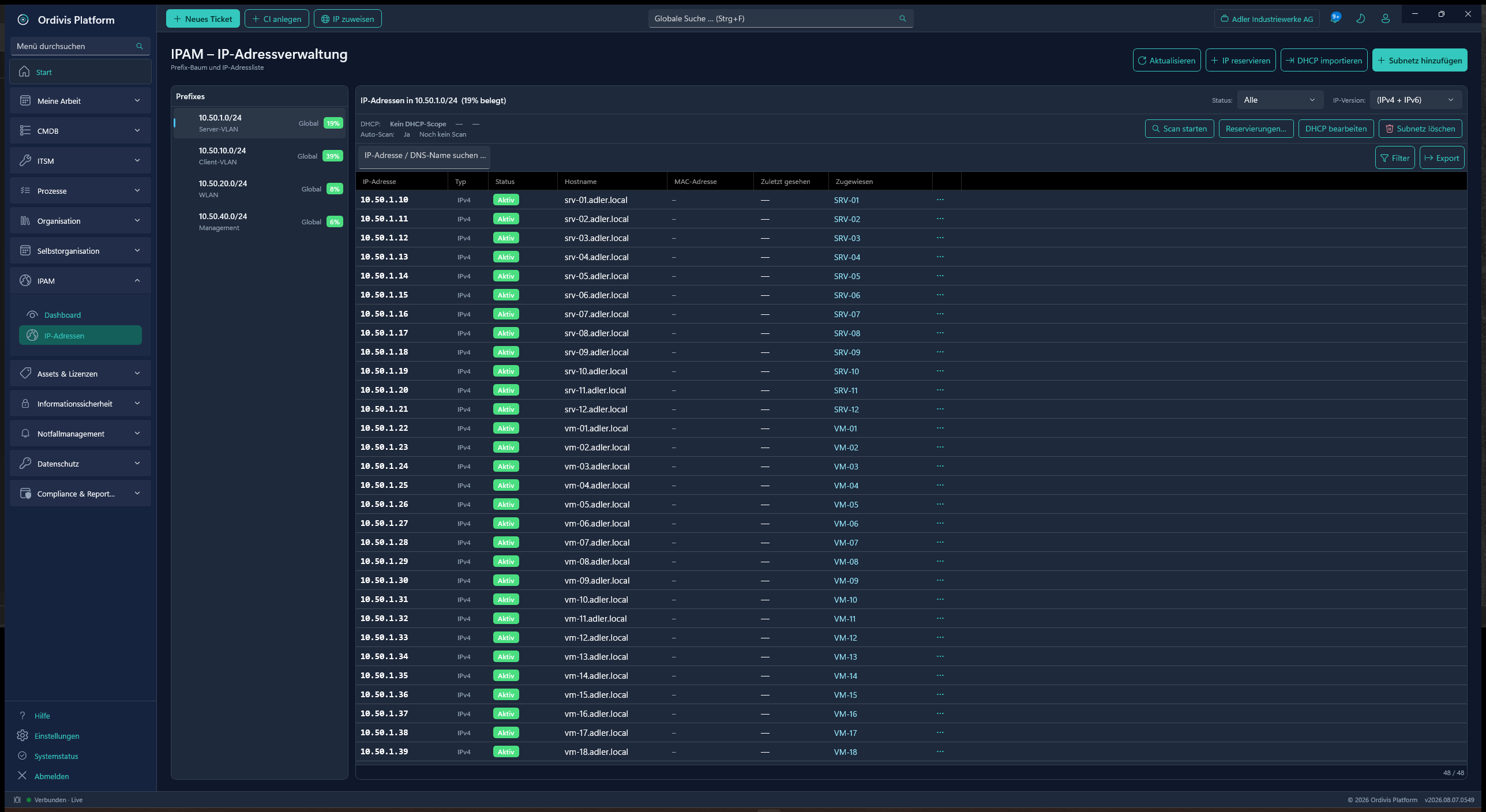
IPAM (IP address management) is the central administration of the IP addresses, subnets and address ranges of a network – including the question of which device sits behind an address and whether it is still in use at all. It answers the three questions at which spreadsheets fail: which address is free, who owns an occupied one, and how full is a subnet?
Because it verifies nothing. A spreadsheet keeps an address as assigned although the device was decommissioned long ago, and it does not notice when two colleagues assign the same address. Ordivis Platform reconciles with DHCP and scans the network actively – the documented state is therefore checked against reality instead of trailing behind it.
The DHCP console knows only the dynamically assigned addresses of its own server. IPAM keeps the whole picture: static and dynamic addresses, reserved ranges, networks without DHCP and documented planning for segments not yet rolled out – plus the assignment to site, purpose and configuration item.
No. Addresses, subnets and networks are unlimited and free of charge in every tariff; billing is by named user. That is a deliberate counter-design to vendors who tier by managed nodes – there it is precisely complete documentation that becomes a cost risk.
Through a link, not through a copy. The IP display on the configuration item comes read-only from IPAM. That way there are no two diverging states of the same address – an error that is practically unavoidable in separate tools.
The subnet and range administration is designed for both address families. You can read the current build status of the module in the module maturity overview – we also publish there what is not finished yet.
The address belongs to a configuration item – linked, never copied.
A network scan and AD sync keep addresses and devices current by themselves.
Every ITIL module on the same data, without per-module surcharges.
Prefix tree, utilisation, DHCP reconciliation and scan – in a demo by video call.