Ordivis Assets
The commercial view of your IT: procurement, depreciation, warranty, licence compliance and contract deadlines – cleanly separated from the operational CMDB view, but on the same master data.
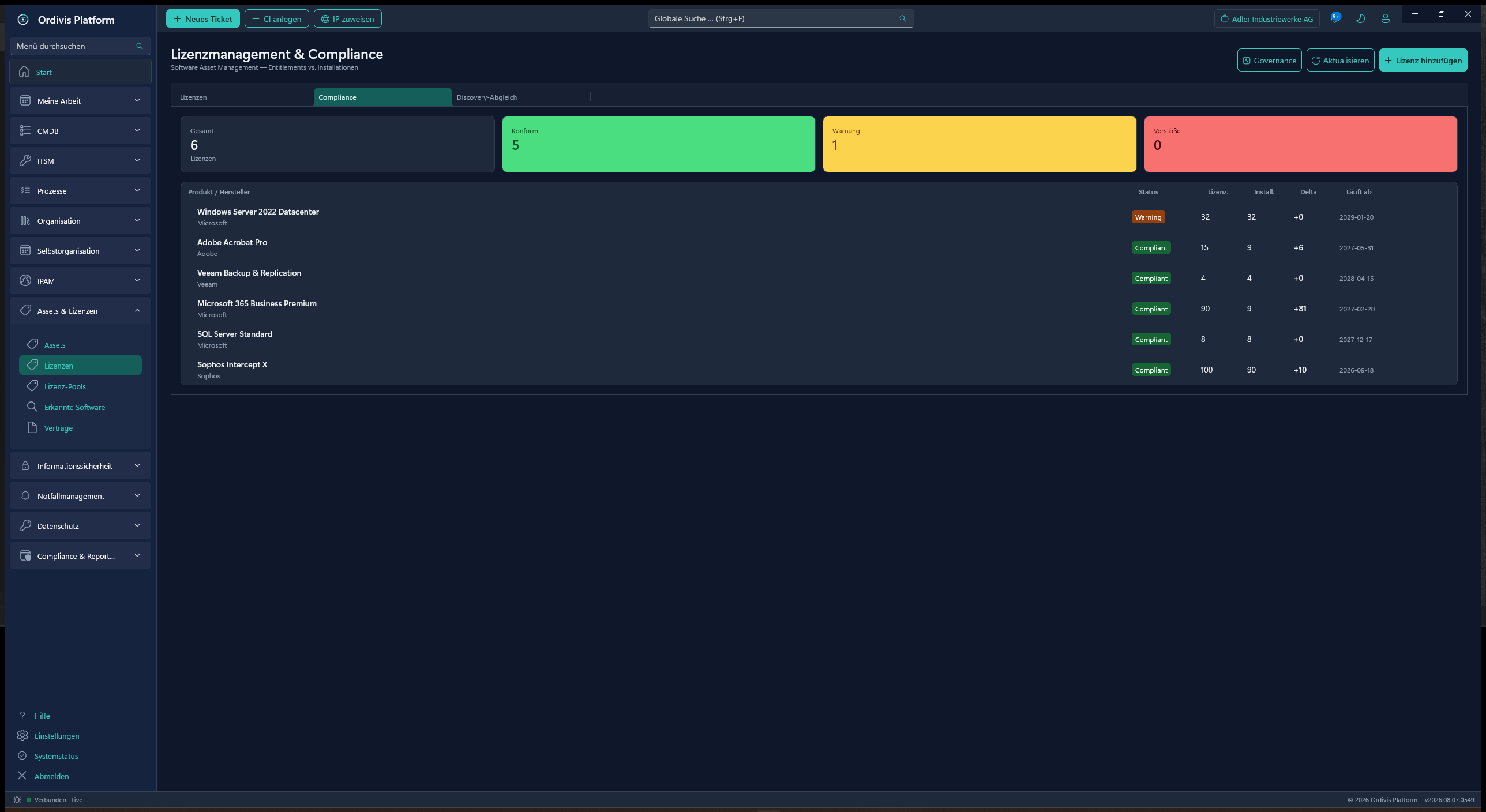
# Licence compliance balance
Product  Office suite standard
 Entitlements    240  from contracts
 Installations  263  from discovery
 Balance          − 23  shortfall

Asset  NB-2291 Lenovo T14
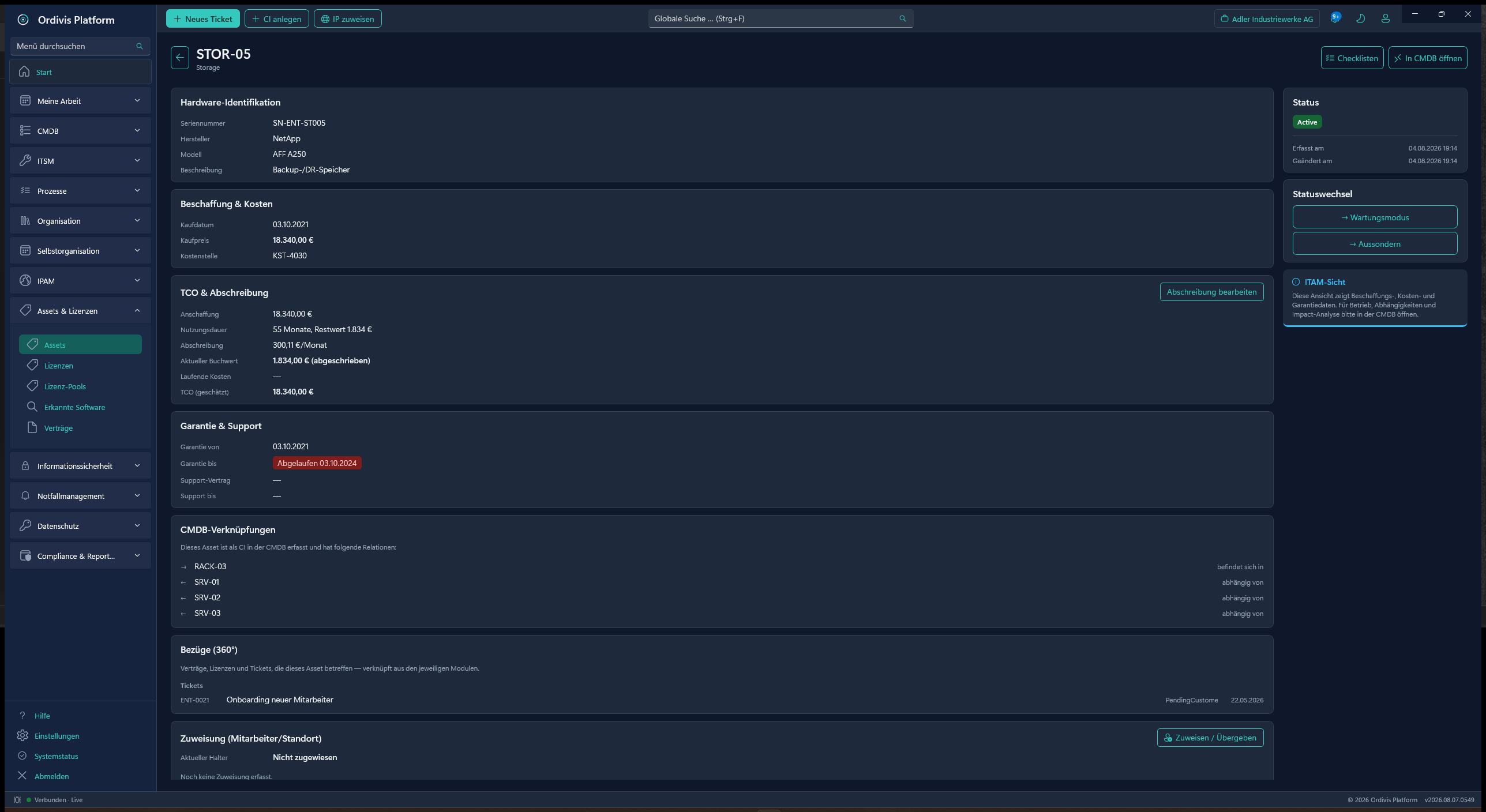
 Purchase EUR 1,489  Warranty until 02/2028
 Contract     Maintenance North · cost centre 4711
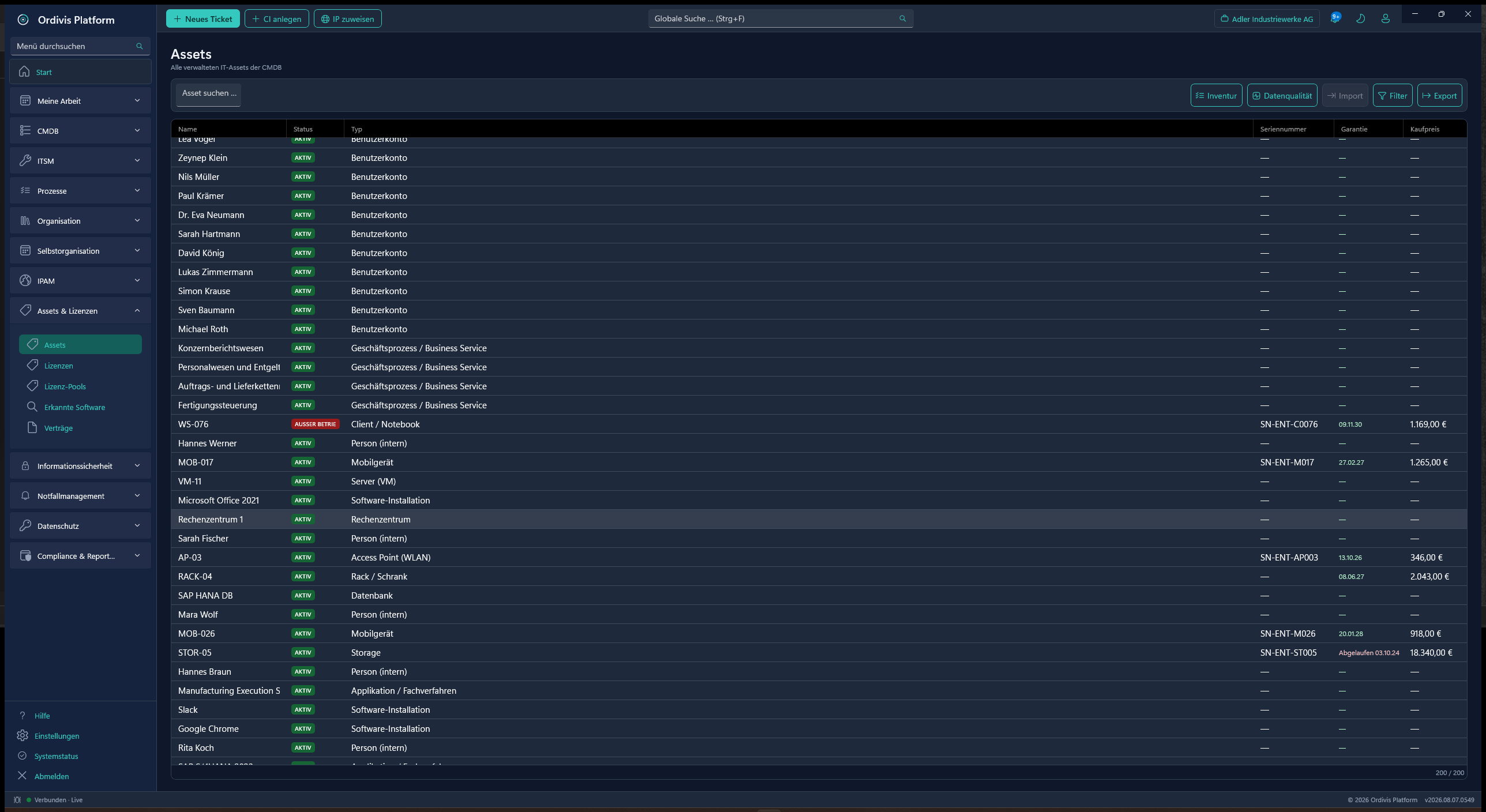
IT asset management (ITAM) is the commercial management of IT assets across their whole lifecycle: procurement, assignment, contract, warranty, depreciation, disposal.
It answers questions that are rarely asked in day-to-day operations and then all at once in annual planning: what did that cost? Who is it assigned to? How long does the warranty run? When does it have to be replaced – and what does that mean for the next budget?
Because they are two different questions about the same object. The CMDB asks operationally: what depends on it, what fails if it breaks? ITAM asks commercially: what is it worth, who owns it, which contract covers it?
The difference becomes clear at the edges. A depreciated notebook in the store room still has to be kept commercially and is operationally uninteresting. A rented cloud service is operationally central and appears in no asset accounting. Forcing both into one list loses one of the two views – usually the commercial one, because operations is louder.
Ordivis Platform therefore keeps them separate but on shared data. That saves the double maintenance of two systems keeping the same devices.
SAM keeps licence holdings and their assignment and sets them against reality in a compliance balance : entitlements from contracts against installations from the discovery reconciliation. Both directions of deviation cost money – a shortfall in the audit, an excess in the budget. They only become visible when contract and inventory data sit in the same system.
From procurement through assignment and location to disposal – with category, status and cost reference, filterable and exportable.
Purchase value, depreciation curve and total cost per asset. The basis for sound replacement planning instead of estimates.
Entitlements against installations, licence pools and discovery reconciliation – the balance shows shortfall and excess before an auditor does.
A dedicated contract module with terms, costs and assignment to assets and CIs. No contract folder beside the system.
Warranty data with deadline monitoring and expiry notification – in good time, not retrospectively.
Procurement, depreciation, warranty plus references to contracts and tickets in one view – instead of five tabs in three tools.
IT asset management is the commercial management of IT assets across their whole lifecycle: procurement, assignment, contract, warranty, depreciation, disposal. It answers questions such as „what did that cost, who owns it, how long does the warranty run and when does it have to be replaced?“
The CMDB looks at a device operationally – condition, dependencies, impact on failure. ITAM looks at the same device commercially – purchase value, contract, licence, depreciation. A depreciated notebook in the store room is commercially relevant and operationally uninteresting; a rented service is operationally central and appears in no asset accounting. Ordivis Platform keeps both views separate but on one set of data.
It keeps licence holdings and their assignment and sets them against actual reality in a compliance balance – entitlements from contracts against installations from the discovery reconciliation. That way you see shortfall as well as excess instead of learning about it in an audit.
Yes, in a dedicated contract module: terms, warranty data, costs and the assignment to assets and CIs. Deadlines are monitored, expiring contracts trigger a notification – in good time, not retrospectively.
No. Assets, CIs, IP addresses and end users in the self-service portal are unlimited and free of charge in every tariff. Billing is by named user – by administrators and service desk agents. There are no node counters and no true-up back payments; compare it in the TCO calculator.
From discovery and Active Directory synchronisation, from imports and from manual maintenance. Machine-projected attributes are marked read-only so that manual maintenance does not overwrite them unnoticed.
The operational view of the same objects – dependencies instead of purchase value.
Record installations automatically – the basis of every licence balance.
Every ITIL module on the same data, without per-module surcharges.
From the purchase value through depreciation to the compliance balance – in a demo by video call.