For the public sector more than a ticket system: municipal product plan, 5,019 administrative processes and your organisational structure in one system – with a schedule of responsibilities that follows from the data. For enterprises the complete ITSM suite without pricing tricks: unlimited assets, every module unlocked, EUR 0 database licence – in your own data centre.
The same product, the same data — but two very different first questions.
Steering happens through products, work happens in processes – and the schedule of responsibilities is supposed to connect the two. Ordivis Platform supplies the municipal product plan and 5,019 administrative processes as a reference, maps your organisational structure with posts, appointments and officer functions in full, and derives the schedule of responsibilities from it – process-oriented rather than product-oriented.
Straight to the topic: Municipalities & CNI · Schedule of responsibilities
The complete ITSM and ITAM suite without the usual pricing tricks: billed by IT administrators and service desk agents, not by assets. Every module is fully active in every licence, the database costs nothing, and operations stay in your own data centre – right down to the air-gapped network.
Straight to the topic: Pricing & TCO · All features
Public administration has planned by products ever since double-entry accounting. Work happens in processes. Ordivis Platform brings the two together – and turns them into a schedule of responsibilities that is not out of date the day it is signed.
Municipal product plan (6 main areas, 16 product areas, 41 product groups, 148 products) and 5,019 administrative processes across 462 specialist tasks – each with its legal basis, without an import. Source: KGSt, CC BY 3.0 DE.
Process map across management, core and support processes, filterable by administrative level. The catalogue creates no records – only adoption creates what you actually carry out.
Units, posts with post identifiers, appointments with a share, officer functions with assignment and deputising. Plus an org chart and CSV exchange for Excel.
Ownership follows from one assignment of product to unit. An audit report names the gaps; a frozen version with PDF and checksum makes the plan citable.
“We show what is – not what sells well.” Guiding principle for Ordivis Platform, Grams IT
We publish the maturity of every module from our project control – including the modules still at 0 %. To module maturity.
What is described on this website exists in the product. What is planned is in the roadmap and is marked as planned.
Support runs exclusively by email and ticket system, with clearly stated response times. We do not promise a hotline that does not exist. To the SLA.
The ITSM/ITAM market lives on complex licence metrics, artificial feature locks and forced cloud migrations. We do the opposite.
Costs scale with the size of your IT team – not with your infrastructure. Whether 100 or 100,000 assets: the price stays the same.
No “standard” edition with stripped-down functionality. IPAM, change, workflow engine, DR – every module is fully active in every licence.
CMDB, IP networks and credentials stay in your own data centre. Fully air-gapped thanks to ECDSA activation – without support escalation.
No Oracle, no MS SQL core requirement. PostgreSQL runs natively on Windows – with optimised multi-tenancy instead of a ponderous graph database.
The full feature set in every tariff. The price scales, not the scope – billed by IT administrators and service desk agents, not by assets.
Cities, districts, administration, critical infrastructure
Trades, law firms, small system houses
Manufacturing, clinics, education providers, branch networks
Corporate IT, CNI operators, IT service providers
What others sell as separate products shares the same master data in Ordivis Platform. Every area explained in detail:
Every ITIL practice in one on-premises suite – incident, problem, change, service request and SLA from day 1, with no per-module surcharges.
What is ITSM? →Ticket system with SLA engine, email integration and self-service portal. End users are unlimited and free of charge.
Service desk or helpdesk? →Configuration items with relations, topology and business service maps. Impact analysis without a second database technology.
What is a CMDB? →ISO 27001 and BSI IT-Grundschutz in the same module – baseline check and risk analysis directly on the CI data.
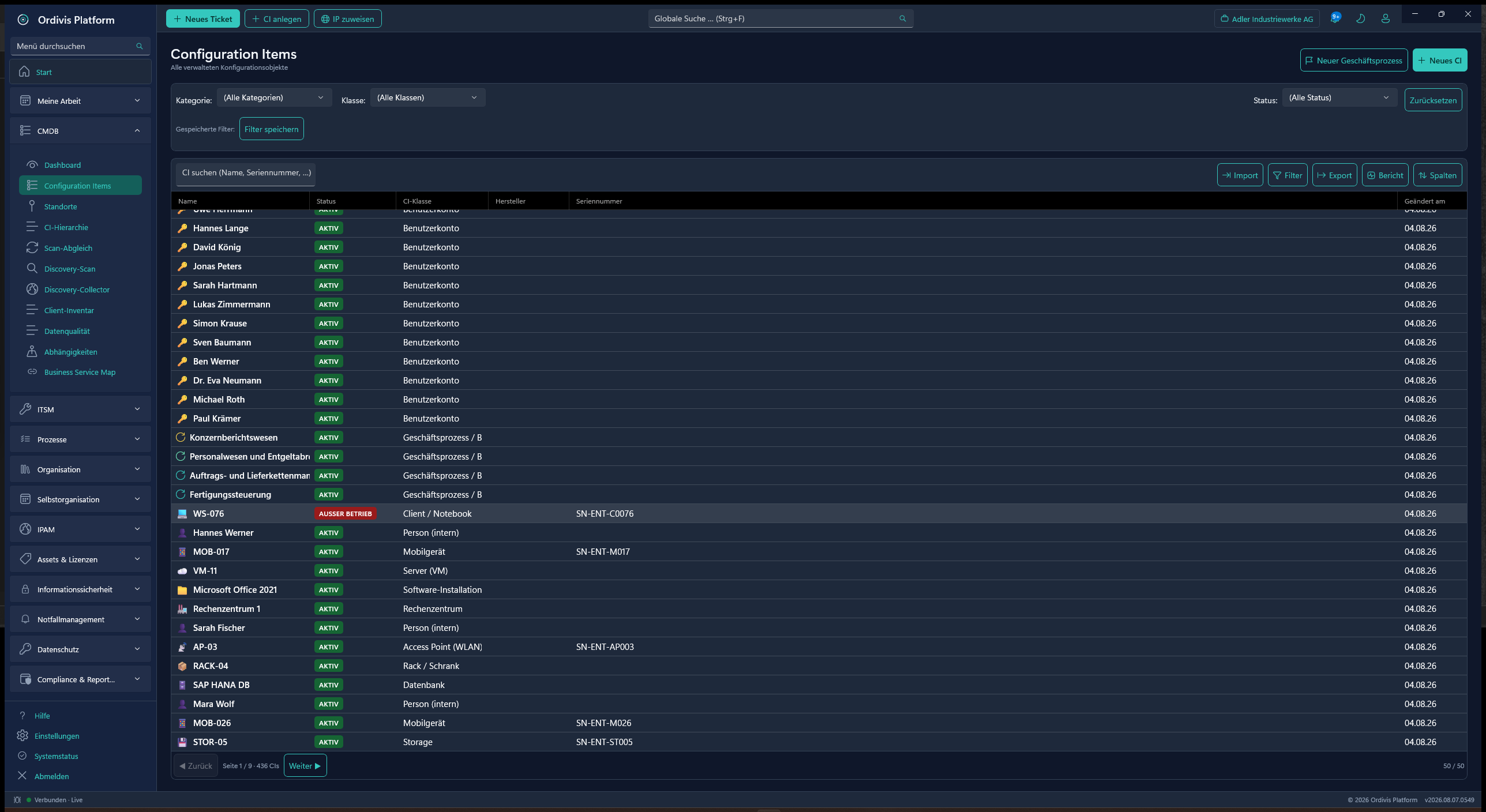
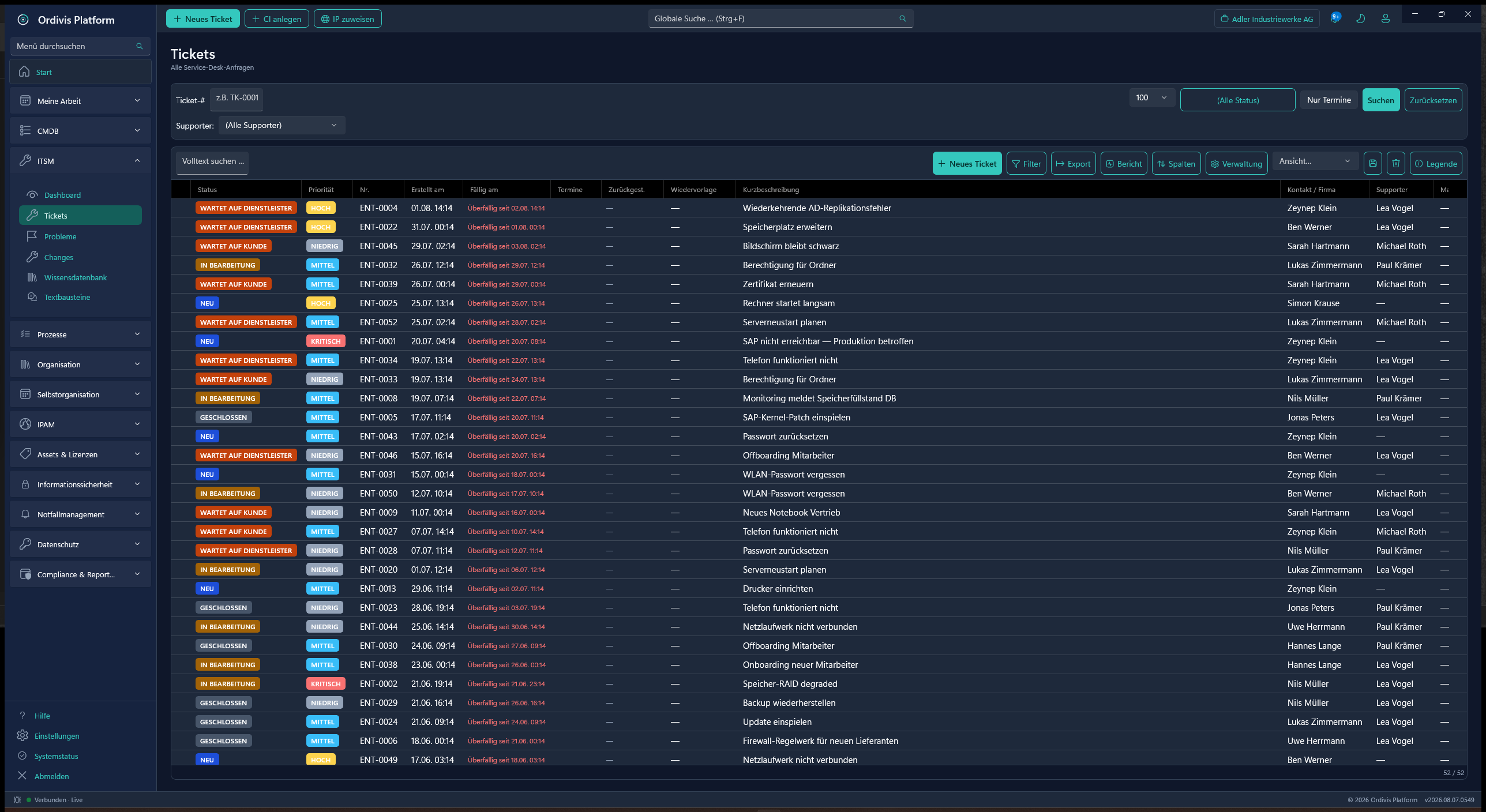
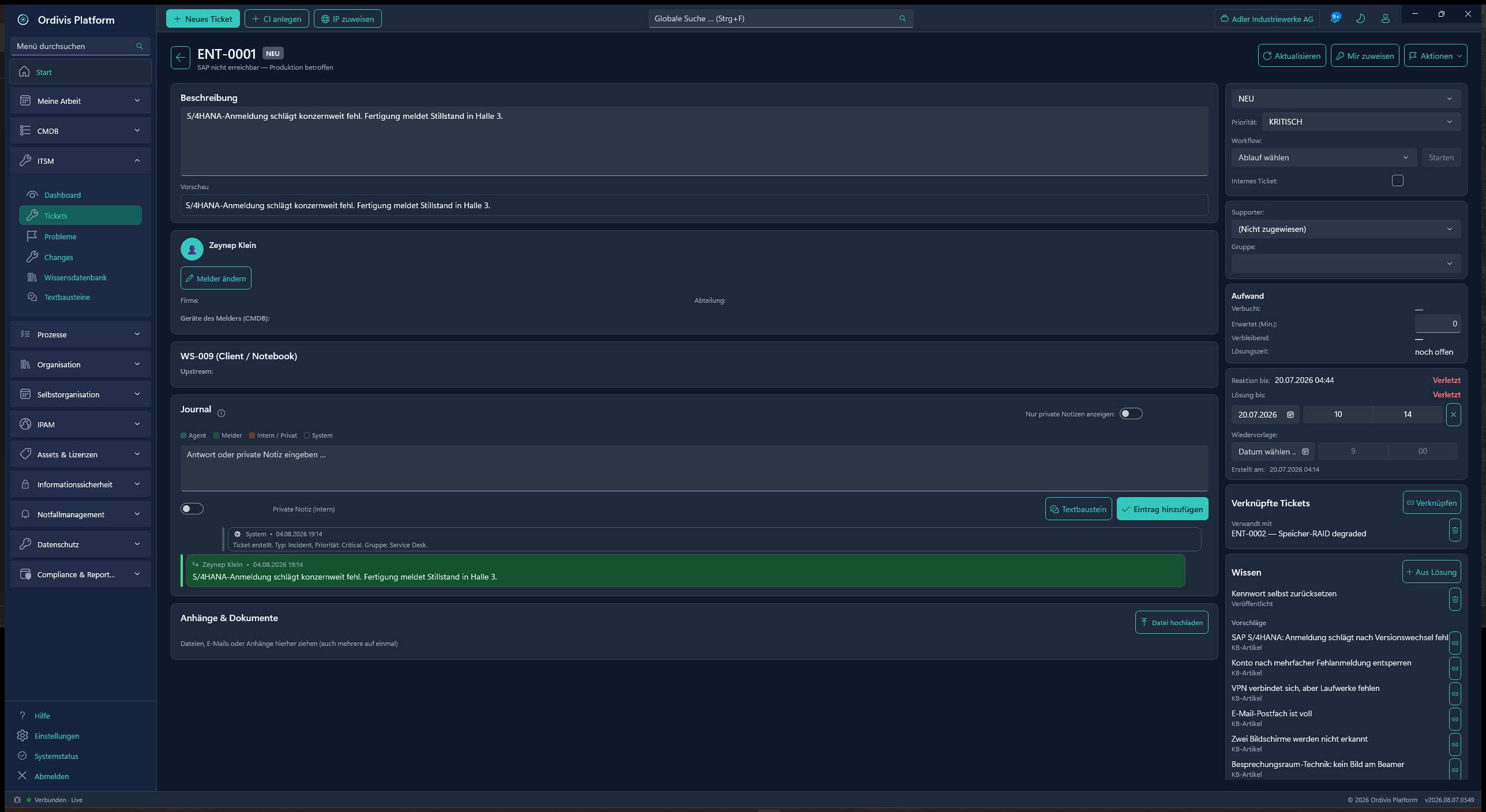
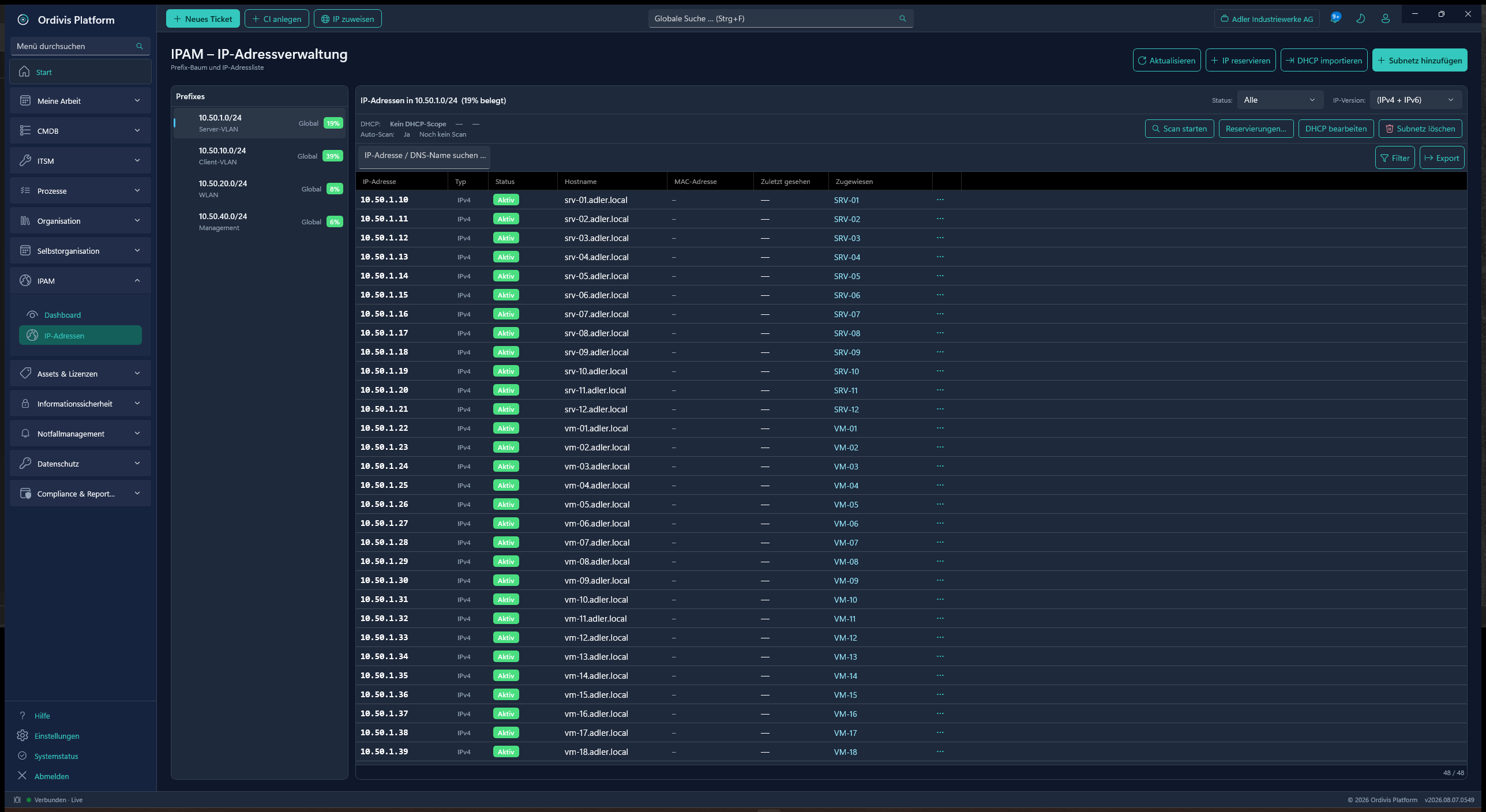
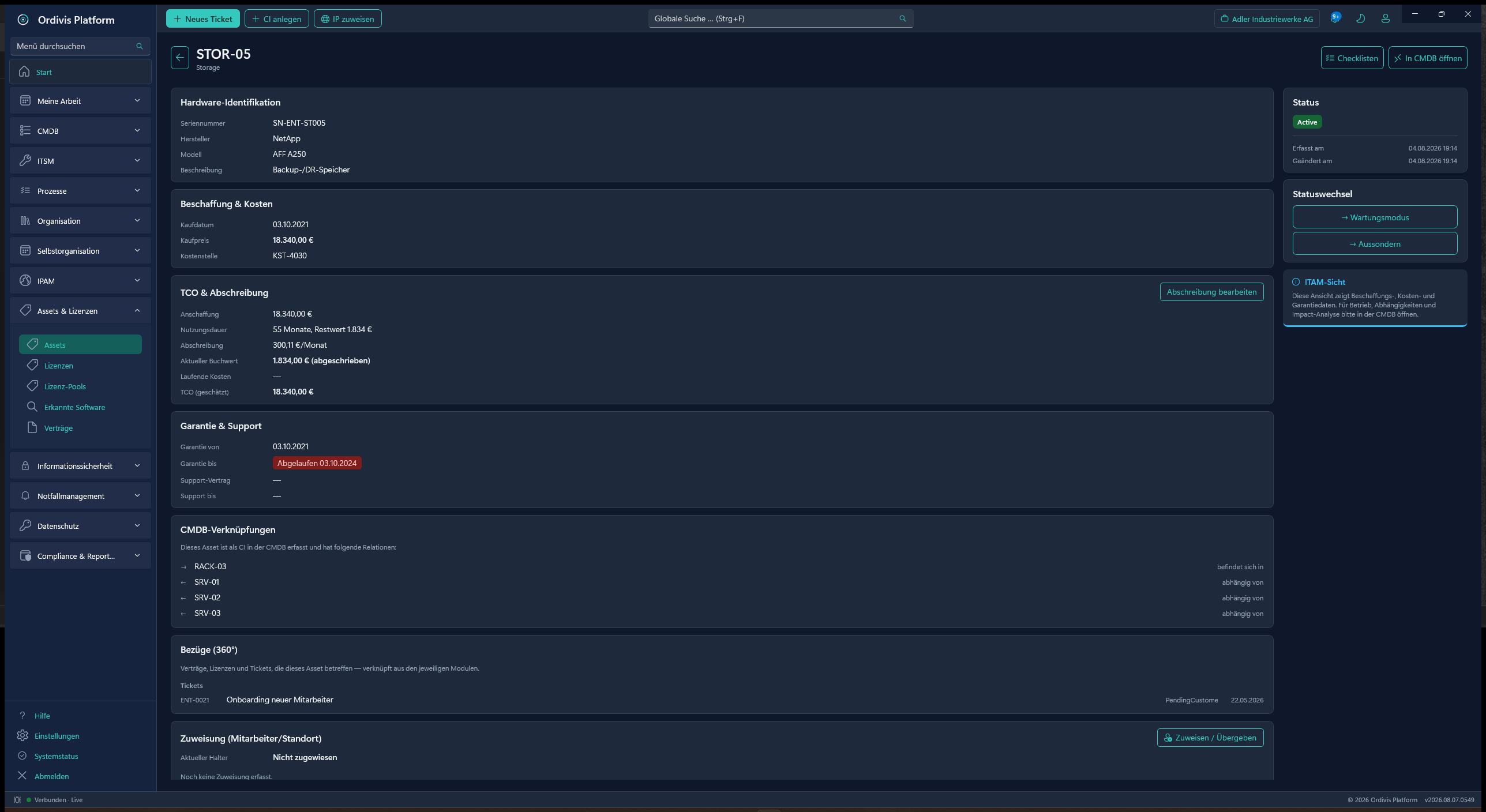
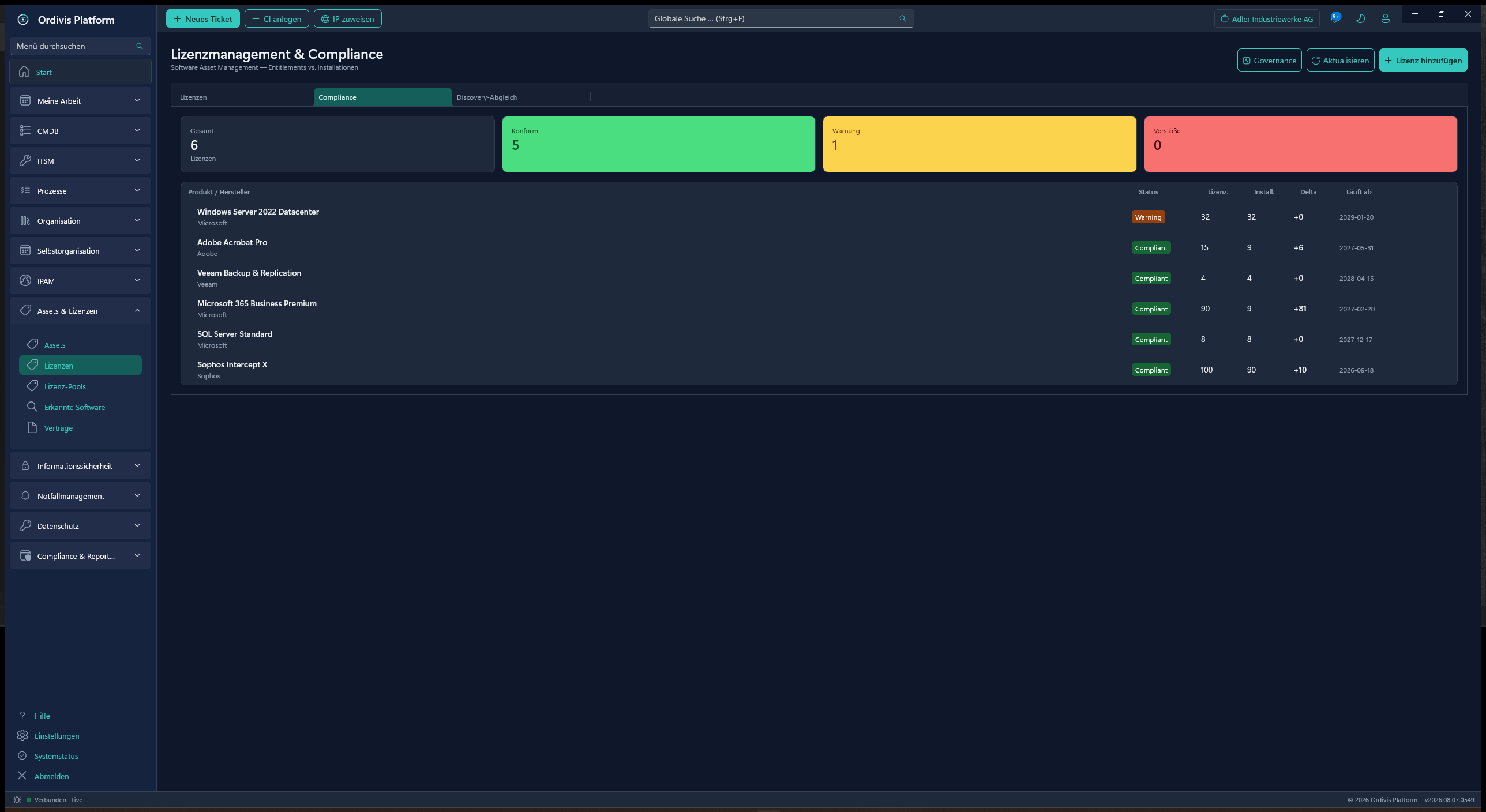
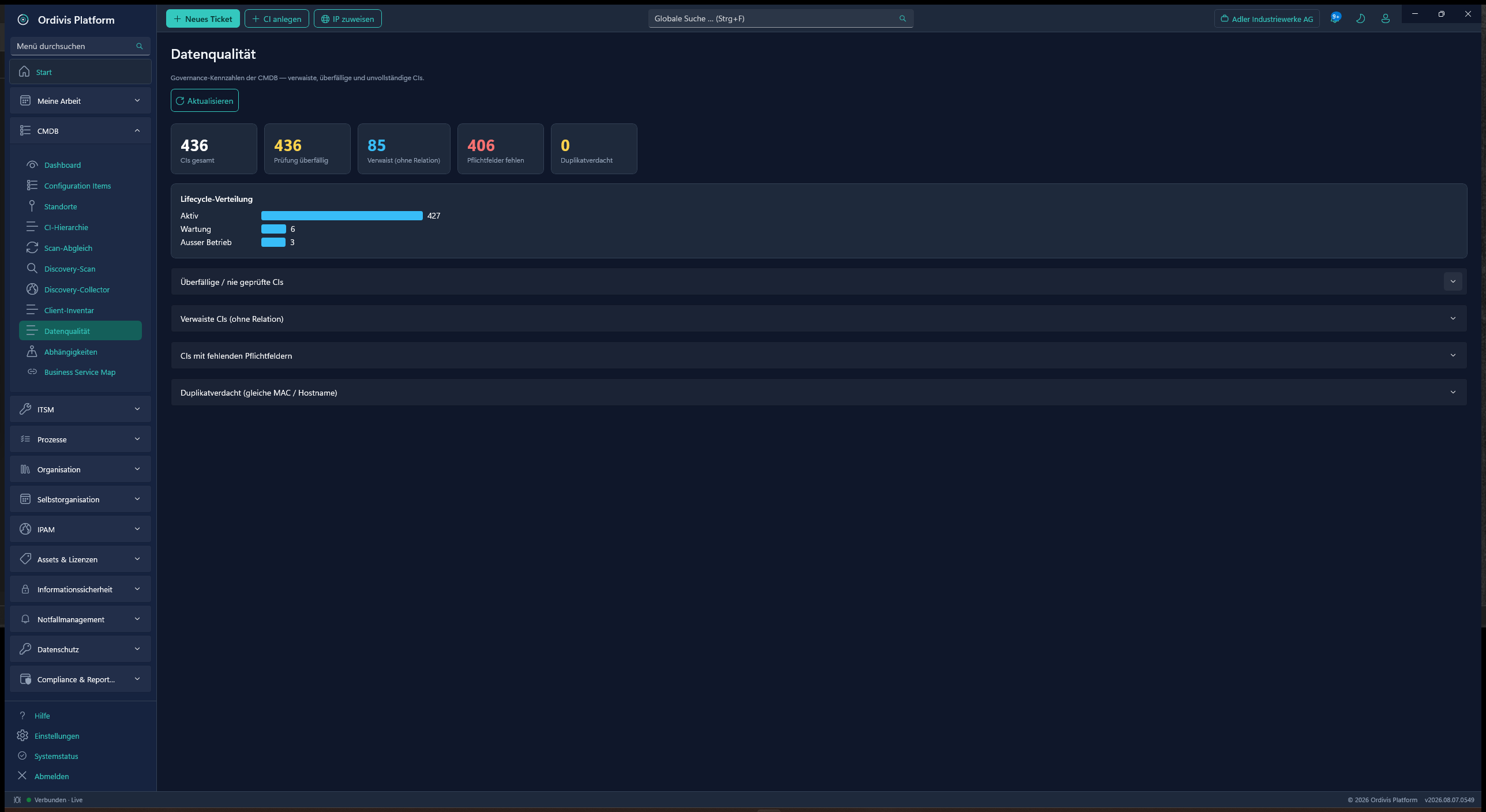
What is an ISMS? →From the personal dashboard through the CMDB to the SLA engine, IPAM and BSI baseline protection – every module in the same consistent, dark WinUI client. Click an image to enlarge it.
See the full guided tour →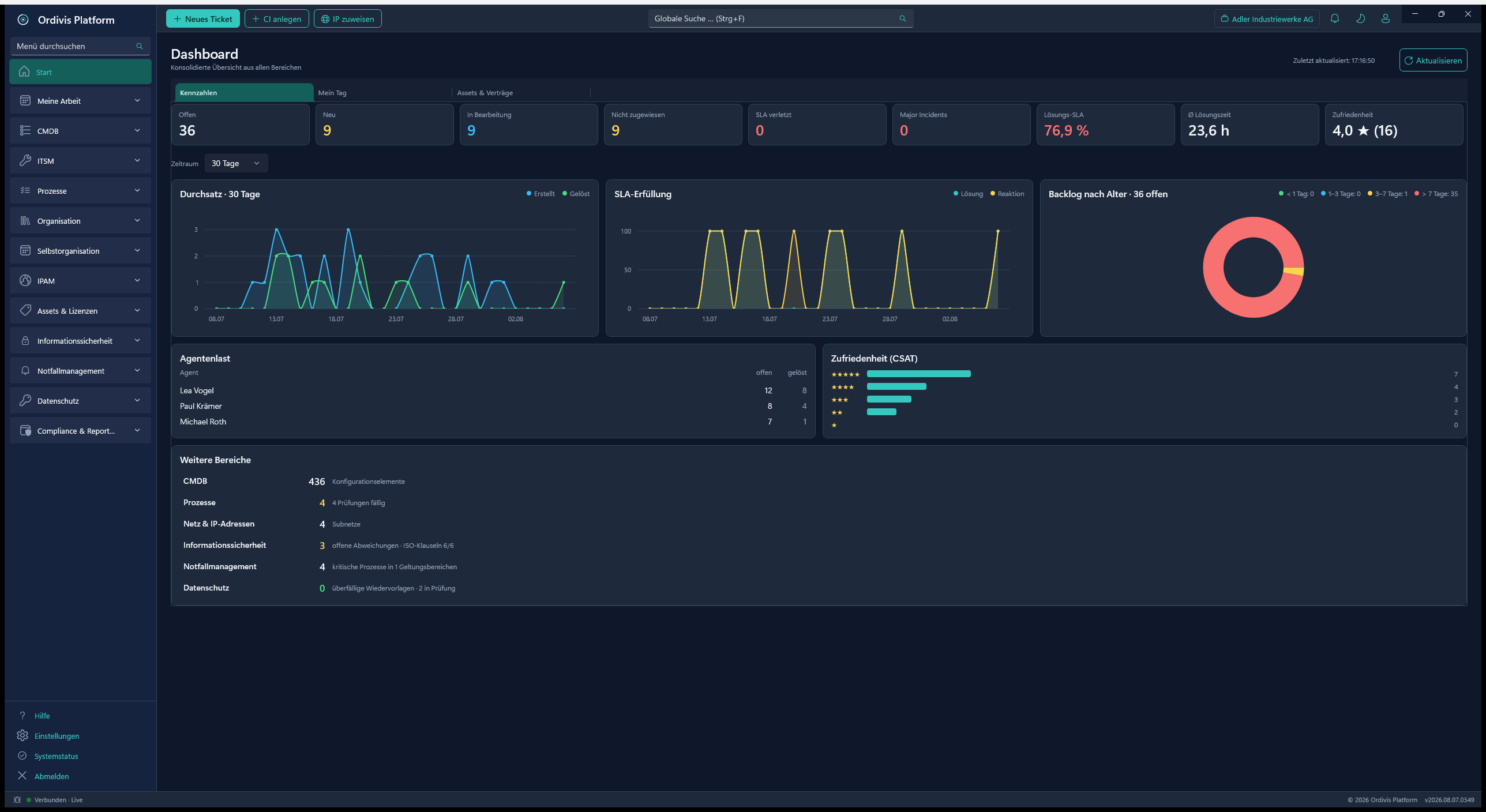
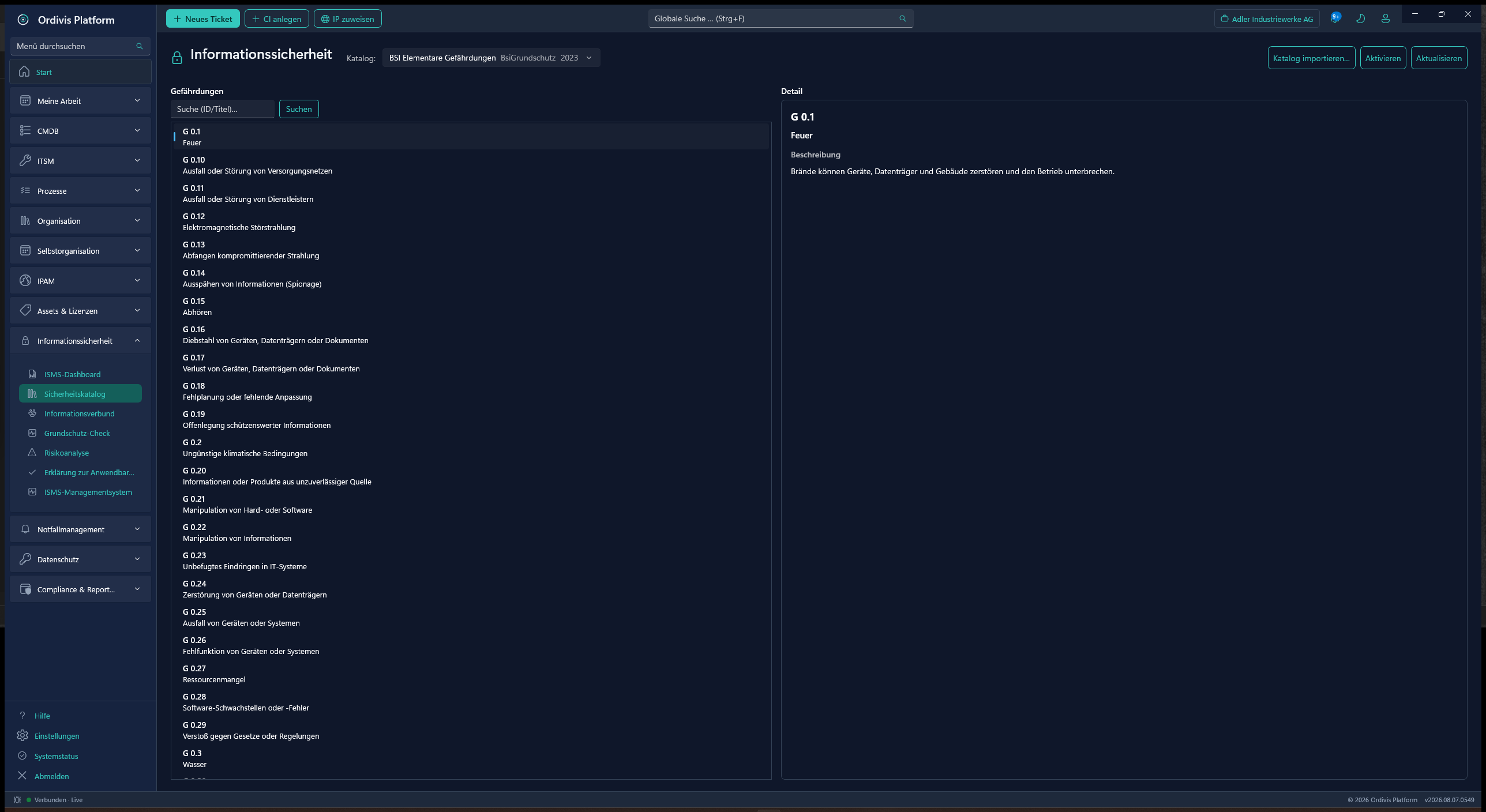
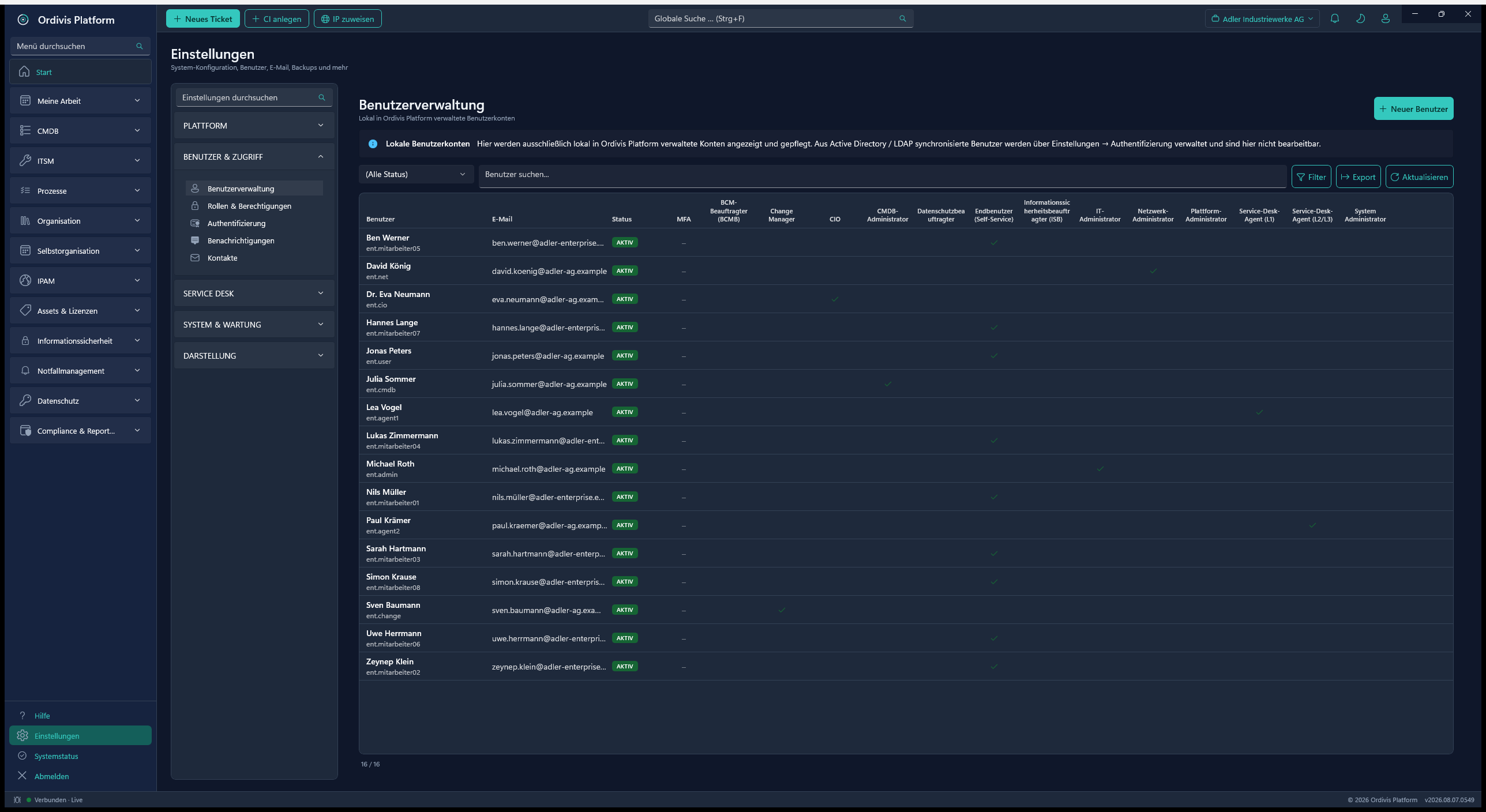
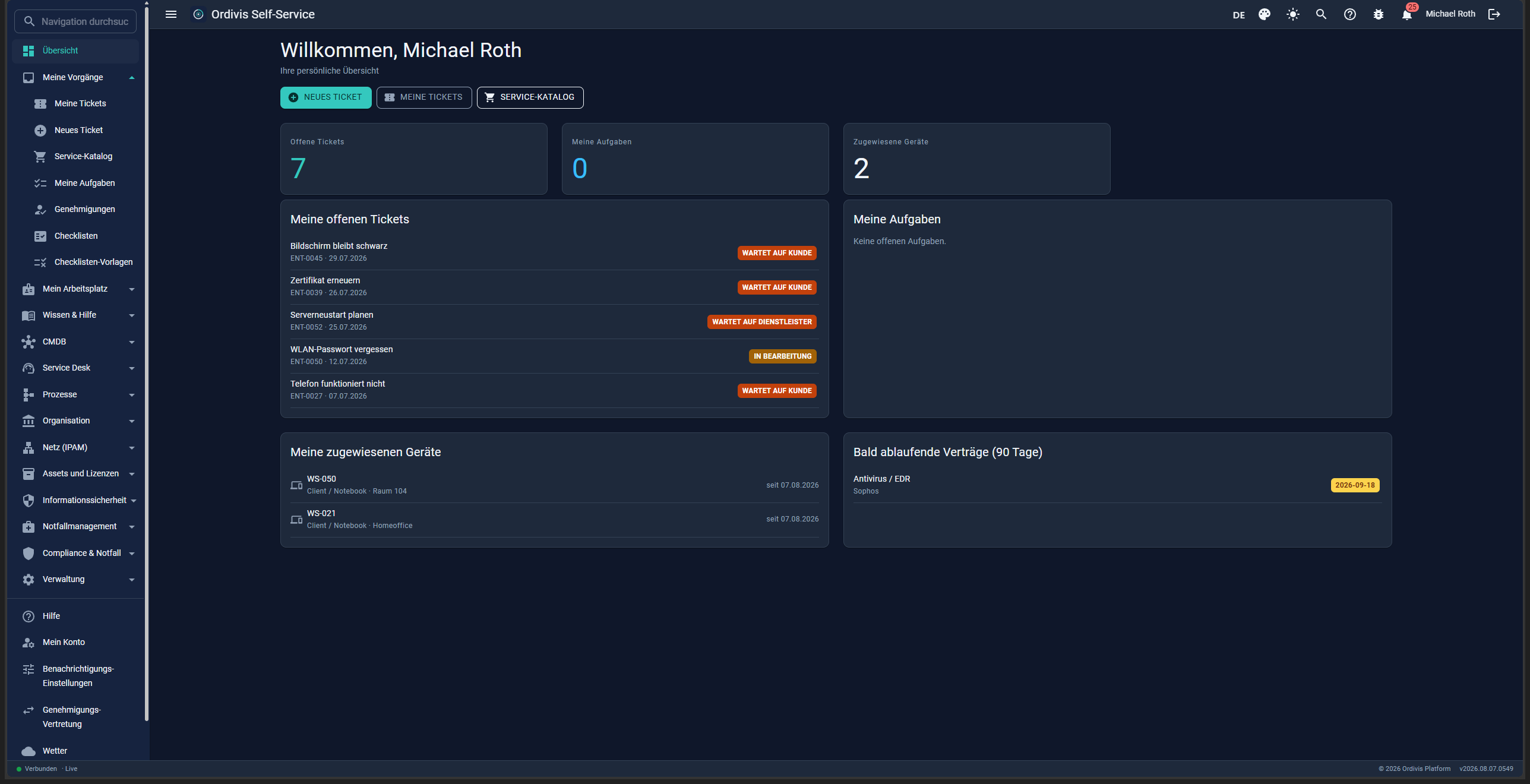
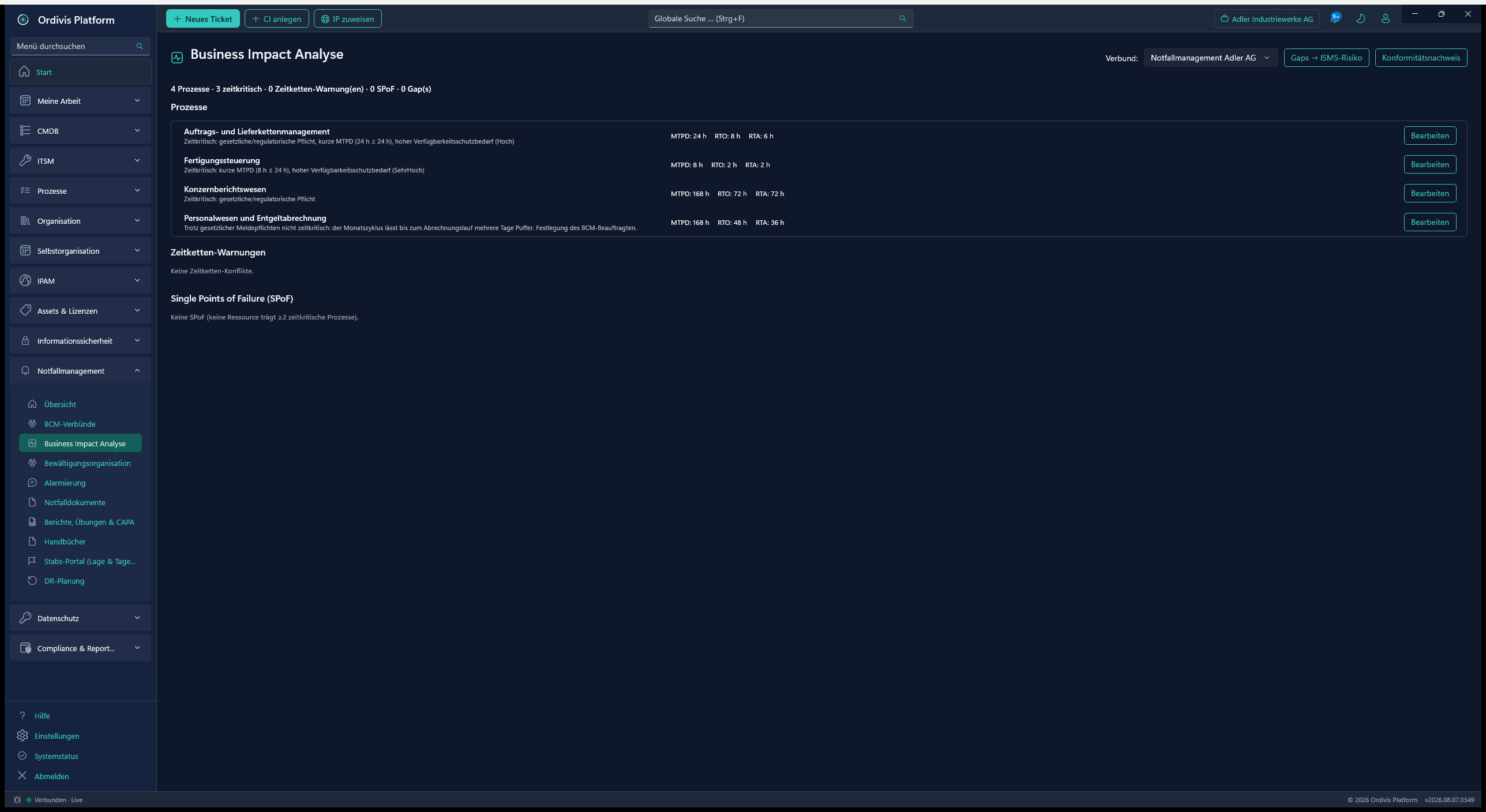
The free toolkit for Windows administrators: network analysis, Active Directory, scanners, PKI and diagnostics in a fast WinUI 3 interface. And as a field assistant for Ordivis Platform it scans remote subnets from the workplace and feeds them into IPAM verifiably.
Established vendors use their pricing power through node licences, module upsells and true-up back payments. Ordivis Platform delivers predictable flat rates and full data sovereignty.
To the price comparison| Traditional market | Ordivis Platform |
|---|---|
| Billing per asset/node | Unlimited assets & CIs |
| Surcharge per ITIL module | All modules “all-in” from day 1 |
| Forced cloud models | 100 % on-premises & air-gapped |
| Unpredictable true-up back payments | Fixed flat rate, TCO plannable |
| Oracle / MS SQL licence costs | EUR 0 – PostgreSQL native |
| Upgrade = migration project with downtime | Delta update: 1 click, auto rollback |
With classic ITSM suites every upgrade is a project: a maintenance weekend, external consultants, a full setup, worrying about the database. Ordivis Platform updates itself as a signed delta – only the changed files, from within the client, with automatic rollback. One click instead of a change advisory board.
Instead of hundreds of megabytes of full setup, only the files that actually changed are transferred – content-addressed and minimal. Fast even over narrow site links.
Every release manifest is signed with ECDSA and verified before it is applied. No unsigned package ever lands on the system – traceable even air-gapped.
A database backup runs automatically before the update; a health check follows every component. If it fails, the previous version is rolled back automatically – no “half-updated” cluster.
Either notify only or fully automatic: the server applies verified updates by itself in the chosen maintenance window (weekdays + time). Done overnight, current in the morning.
The available version, the affected components (API, portal, client) each with their version, and the prepared change log – all in one place in the client.
If API and portal sit on separate servers, an orchestrator coordinates the correct order (API first, because of the migration) – via a slim update agent on each host.
What is new is right there in the client – grouped into New / Improved / Fixed / Security and highlighted with “New in this version”. No searching through release notes.
The entire update path runs inside your environment – no third-party cloud, no forced telemetry. Sovereignty is preserved while updating, too.
With established suites the update effort is a hidden TCO driver. Ordivis Platform reduces it to a footnote.
How the update procedure works →| Classic ITSM update | Ordivis Platform |
|---|---|
| Full setup, hundreds of MB | Signed delta – only the changes |
| Planned maintenance weekend | 1 click or an automatic maintenance window |
| External consultants / upgrade service | By your own admin, without a project |
| Failure = manual restore | Automatic rollback + pre-backup |
| Cloud/telemetry dependency | On-premises & air-gapped capable |
No licence audit, no maintenance weekend, no consultancy project. Ordivis Platform is built so that a single admin keeps it under control.
Two numbers are counted: your administrators and your service desk agents. Assets, CIs, IP addresses and end users are unlimited – no node audits, no true-up back payment at the end of the year.
One installer sets up the API, the portal and PostgreSQL as native Windows services. No Kubernetes, no SQL Server, no Linux know-how needed in the team.
A signed delta with a prior backup and automatic rollback – one click or fully automatic in the maintenance window. Done overnight, current in the morning.
The two main paths are above. These four pages answer a narrower question – budget, responsibilities, tenants, architecture.
A budget-safe ITSM flat rate, tied firmly to the population figure. No true-up risks, plannable across the whole term.
The schedule of responsibilities follows from the product plan, the process catalogue and the organisational structure – instead of being written separately from them.
One server, many customers. Every tenant gets its own PostgreSQL database instead of its own virtual machine.
Why a modular monolith on .NET 10 instead of microservices – and what that means for operations, updates and data sovereignty.
By named users in two roles: administrators (the full feature set including the service desk) and service desk agents (ticket handling only, cheaper). Assets, CIs, IP addresses and end users in the self-service portal are unlimited and free of charge in every tariff – no node counters, no true-up back payments.
No. Ordivis Platform runs on PostgreSQL, natively on Windows Server – EUR 0 in SQL licence costs. Neither Oracle nor Microsoft SQL Server licences are required.
Yes. Ordivis Platform runs entirely in the customer's data centre as native Windows service infrastructure with its own PostgreSQL database. Thanks to ECDSA offline activation, air-gapped operation in isolated critical-infrastructure networks is possible too.
Little. Installation including PostgreSQL provisioning takes under 10 minutes. Updates are applied as a signed delta with automatic rollback – one click or fully automatic in the maintenance window, without external consultants and without a migration project.
Yes. There is no stripped-down standard edition. Every licence contains the full feature set: CMDB, service desk (incident, problem, change, service request), IPAM, IT asset management, ISMS, BCM, the data protection record of processing activities and more – all-in from day 1.
Yes, to the three that matter day to day. Identity: Single sign-on via OpenID Connect (Entra ID, Keycloak) with role mapping, plus integrated Windows authentication and a read-only AD/LDAP reconciliation. Monitoring: Faults from CheckMK, PRTG, Zabbix or Nagios/Icinga become cases – deduplicated, with maintenance windows and automatic all-clear. Email: Ticket inbound and outbound including OAuth2 for Microsoft 365 and Gmail.
Not as a slide deck: the first pilot customer is already using it in day-to-day business. We will show you that same state live by video call – or register for the trial phase that starts with general availability on 1 January 2027.